A guide to keep you informed about the night sky over Oneonta, NY, brought to you by the astronomer at the SUNY College at Oneonta.

Tuesday, April 29, 2014

Oneonta Stargazer...signing off

It has certainly been awhile since I've posted.  This semester has been busier than any other and I've had many late nights just keeping up.  One element that has kept me busy is that I have been interviewing for faculty positions elsewhere, and have accepted one at Calvin College in Grand Rapids, MI.  My wife and I will be moving at the end of May.

I apologize for the inconsistency from time to time, and for not posting at all this semester.  I have enjoyed my time here in Oneonta, and have enjoyed the opportunity to provide you (the reader) with updates about the night sky's events. 

All the best, and happy viewing,
The Oneonta Stargazer

Saturday, October 5, 2013

The October sky: getting us warmed up for ISON

This year has seemed to be chock full of fun celestial happenings. There was comet Pan-STARRS in March (near center, and shown enlarged in the inset):

and then there was the three-planet conjunction of Mercury, Venus, and Jupiter in May:

As Venus loitered in the post-sunset sky throughout the summer, Saturn marched across the sky and joined it in September, when they ultimately passed just a few degrees from one another (much closer than shown in this picture):

With all this taking place, one could be forgiven for possibly forgetting about the final act of the year: comet ISON. This comet was forecast to be the "Comet of the Century" (never mind that the century has really only barely begun - seems fairly pessimistic if you ask me) and while it has been getting brighter as it nears the Sun, it hasn't brightened to the level that was expected. It's thought that this is the maiden voyage Sunward for this particular comet from the far reaches of our solar system, and as such the relative inexperience of this comet makes it a bit tough to prognosticate about with certainty. The bottom line at the moment is that it should still be easily visible to the naked eye, even if it isn't visible during the daytime. This still makes me excited!

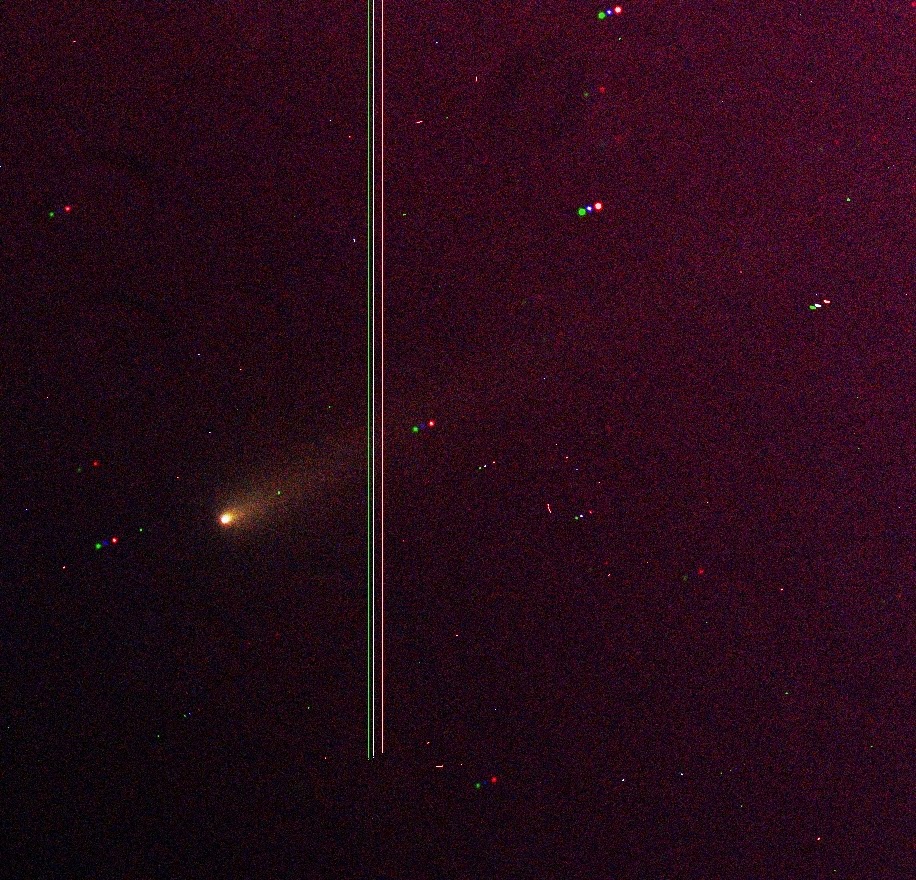
It only just flew past Mars on its way toward a close encounter with the Sun and has yet another month and a half yet before it loops past our star. Nevertheless, I took an eager opportunity to catch a picture of it:

The image is admittedly not great, for several reasons. The first is the unsightly lines down the center due to a column of dead pixels in the CCD I was using. Since the comet is moving, when I aligned the three comet images I took (one for each colored filter) the columns appear offset. There is really only one dead column - it just shows up three times because this is a composite of three images. I could have moved the comet off this dead column if it wasn't for the second reason: I was racing the sunrise. ISON appears early in the morning before dawn, with Mars, so by the time it's high enough to image then the Sun is preparing to make its appearance as well. This is what caused the red hue in the image: the red filter was the last image I took, so the glow of dawn produced a gradient in the image I couldn't easily remove. But regardless, I still captured it! And it's only going to get better. That is, unless it breaks up - which some believe it may. These first-time visitors to our inner solar system sometimes end up being a bit weaker in their structural integrity. We will see.

If the comet does survive and become visible to the unaided eye, here is one resource you won't want to overlook. It is an "atlas" of where to find the comet in the sky - but be warned, you will have to wake up before sunrise to see it! If ISON survives, late November and into early 2014 should be great for viewing.

In the meantime, the Orionid meteor shower peaks on October 21, although the Moon may be a bit on the bright side. As we move into the autumn months, keep your eyes on Gemini (north of Orion). You'll see an amazingly bright point of light in that constellation of the twins: that bright spot is Jupiter! This means it's time to go grab those telescopes, because it's time to watch the Galilean moons in their orbital dance, as well as time to spot the Great Red Spot. Saturn has set behind the Sun, but we now have the King of Planets to observe instead. There's always something to see. Happy viewing!

Update:  Here is a better image I captured on 10/4/2013

Thursday, August 8, 2013

Shooting the (shooting) stars

My wife and I went back to Michigan recently for my sister's wedding and during our stay we had a couple nights that were both dark and clear. Since it was right around the peak of the Delta Aquariid meteor shower, I thought I'd take my Canon Rebel T3i out and try to do some Milky Way photography with the hopes of catching a meteor.

Standing under those twinkling stars, with the great Milky Way arching overhead and no Moon in sight, I had high hopes. Almost as soon as I stepped out I saw a meteor flash through the Milky Way. Although its path told me that it wasn't a Delta Aquariid meteor, my first thought: "This is going to be a good night."

Setting up my tripod, I spent a few minutes focusing the camera. While I'm still not sure if I'm getting it perfectly focused, I'm getting better at it than I was when first using the camera. It turns out that when there's nothing bright to use for focusing, getting nice sharp stars is difficult. However, after a few minutes I was satisfied so I set up pointed at the Galactic center, just above the treeline, and began taking 20-second exposures at ISO 1600. ISO 3200 made the image too noisy. I had the aperture down to f/8, but the treeline was fairly nearby and I didn't want it completely fuzzy just so I could have an f/3 aperture. I wish I knew how the professionals got such sharp horizon features.  But I guess this isn't bad.

After some waiting and snapping, I spotted a small meteor flash through the area of the sky I was imaging! I paused to check the image to see if I had captured it. No. Huh...I guess it was too faint. I learned quickly that not every meteor that you see makes it into the picture. This means that the images from the more skilled astrophotographers show meteors that must have been really bright! I clicked on.

Another flash, this one brighter but shorter in length! I checked the image, and sure enough - I got it!

I clicked away some more, turning the camera occasionally more east and upward, then back to the Galactic center. After taking so many images of the same scene, some pretty neat things can be done with them, like stacking images together to bring out greater detail (notice how there are more stars):


and even making star trails set against a Galactic backdrop:


I finished the evening around 12:30 (though this is actually when I should have started, no doubt) and went to bed, uncertain about whether I had captured any more meteors or not. I sure saw my fair share, though.

Upon looking through the images on my computer, I learned that not only are meteors tricky to catch, but catching other things can be tricky too. For example, I came across one image with a streak that I thought was certainly a meteor. However, after looking at the next frame, I noticed a similar streak in a slightly different location. The next frame showed the same thing:
I had captured a satellite, too dim for me to have noticed it while shooting but right there in plain sight on the image. Silly. After looking through all my images, I came across one more faint meteor, though this one took some heavy image processing to bring out:

I probably spent about an hour and a half, so to get two meteor images against a nice Milky Way background is great. While I saw no fireballs, I probably could have stayed up longer if I really wanted to try for a nice image. While packing up at the end of my shoot, I noticed that my lens had fogged up with dew, so I'll have to remember that for next time.

Next time! The Perseid meteor shower is coming up in a few days - peaking overnight on Aug 11/12. Meteor activity is already ramping up, so I'm looking forward to it. That is, if Oneonta gives us clear skies. Keep your fingers crossed! If it's clear, I'll be outside once again, giving the astrophotography thing another shot. If you'd like to simply enjoy the sight, face northeast around 11 p.m. and look about halfway up (you may want a lawn chair to sit on or a blanket to lay on). Pay attention with your peripheral vision, too. The show should only get better after midnight.

Happy viewing!

Thursday, June 6, 2013

Conjunction month

As we orbit around the Sun, and the other planets with us, there come instances where two planets are lined up in the solar system in such a way that, from our viewing perspective on Earth, they both appear very close to one another in our sky. Such an alignment is called a planetary conjunction, and these sights can be quite charming. In one of my posts last year, I included a couple images taken at the SUNY Oneonta Observatory of a conjunction of Venus and Jupiter.

Conjunctions of three planets are a bit more rare, and seeing them can be downright exciting. Okay, maybe it's just me! Jupiter has been gradually moving across the night sky over the past months and is now fading into the sunset with each passing night. However, seemingly all of a sudden, at the end of May Venus and Mercury popped up out of the sunset to join it. May 26th marked the date of their closest approach to one another in our sky - their closest conjunction.

On that night, my wife and I were driving along the freeway in western New York state. It was a clear night and I had our Canon Rebel T3i DSLR camera + tripod, hoping to catch a shot. We stopped at a rest stop after sunset, but the view was not great:

We continued on our way, and I was happy to have gotten a series of images, with the best one shown above, and I was pleased to have been able to see it. However, the best was yet to come. The hills and ridges that obscured the view of these three planets broke open and we were suddenly driving along a flat stretch of highway. Seeing this, Ashley quickly pulled over and I set up my tripod on the side of the freeway. In between passing cars (who were no doubt wondering what was going on), I snapped a series of shots of the conjunction once again:

This experience was thrilling! I had plenty of time to make sure the camera was focused - a nontrivial task, I'm learning - and got a nice sequence of images of these three planets at their closest approach - just three degrees apart!

While this apparition is gradually dispersing, and Jupiter is now passing out of sight, the two inferior planets are not finished with their tango just yet. Over the next few weeks, these two planets will turn back for another pass at each other as Mercury moves back toward the Sun. The pair will even be joined by a thin crescent Moon on June 10.


(Images produced with Stellarium)

If you have a clear view of the northwestern horizon (no trees, hills, mountains, etc.), keep your eyes peeled after sunset each day. From Oneonta, this is a tough thing to view unless you are fairly high up.

Happy viewing!

Tuesday, May 14, 2013

Astrophotography and the May sky

The whirlwind is over! I'm embarrassed to see that my last posting was back in March. The last month of this semester has been just crazy with grading, reports, meetings, and all that. But it is finally over (mostly) and now I look forward to the summer. I'm teaching an introductory course during the first summer session though, so the break won't last long.

Over the last several months we have had some exciting things happen in astronomy. The comet PAN-STARRS flew by and I was able to share with you a picture of it on the western horizon. Stash and I went back a week later to observe it again and while I took more images, they did not turn out very well - it turns out that a camera is hard to focus when it's dark outside. I'm still learning. We observed it again in the telescope, but this time it first required using the camera to find it on the sky. Stash painstakingly slewed his telescope around in the vicinity of the comet for what must have been 10 or 15 minutes until it finally popped into view. Much dimmer, but still exciting!

It has now receded off into the darkness of the northern sky, a target for astroimagers with large telescopes and/or CCD cameras. In the meantime, I've continued developing my hobby of astrophotography by taking star trail images. Here is one of some trails over the observatory:
This image was created by turning up the ISO to 1600, turning down the f-stop to 4.5, and taking a series of 15-second exposures. The nearly full moon that night illuminated the observatory setting nicely. These images were then stacked with Photoshop's "Lighten" mode, thus allowing their light to add upon each other. However, as you can see, each trail has a small gap in it where I must have stopped for a reasonable moment to check something. Grr!

So I tried again:

There was no moon that night, so I had to use a flashlight to "paint" in the foreground. This image turned out pretty well, though the foreground buildings might be a bit too bright.
One last try, this time while camping with a few buddies:

This time, I turned down the ISO setting to 800 to reduce some of the electronic noise, increased the f-stop to 8 to increase the field depth a bit, then compensated by increasing the exposure time to 20 seconds. This is a compilation of 85 consecutive images, stacked together. The star trails themselves turned out nice, and the foreground trees are illuminated by the campfire. What is that bright streak through it, you ask? During a couple of these exposures, one of my friends walked in front of the camera (he didn't know I was taking pictures at the time) while wearing a headlamp. I think it adds an interesting artistic element to the picture, so I'm not altogether unhappy with it. I couldn't throw that exposure out because it would have left a gap in the star trails. That's okay though - it looks pretty cool nonetheless. Another such streak appears at the bottom of the image.

We've moved into spring now, and Orion and the winter constellations are basically gone for the year. What is there to look at now, you ask? If you turn to the north-east, Hercules is rising which means the Hercules cluster (Messier 13) is becoming visible. That's a binocular target, so aim for the west side of his broad "chest plate" and about halfway in between the two stars on that side. Look for a fuzzy spot, which represents a globular star cluster comprised of hundreds of thousands of stars, all very old indeed.

Saturn is nice and bright and will be for almost the entire summer:
Jupiter is on its way out for the year, but if you keep an eye on the western horizon you'll begin to see Venus appear nearby. They make a close pass on May 27 just after sunset, but look carefully. It will be quite low on the horizon, so if there are any trees or hills to your west you may not see it at all. Venus will continue to rise higher as the weeks progress.

That's all for now. I will report back at the end of the month with (hopefully) more images and an update on the June sky. Happy viewing!

Thursday, March 21, 2013

A comet's tale

Oneonta weather giveth and Oneonta weather taketh away.

With comet C/2011 L4 (PAN-STARRS) having crossed into the northern hemisphere skies over the last week and a half, I have been excited to not only get to see it myself but potentially have my students observe it during an outdoor lab. I even entertained the thought of a public observing night, having already been scheduled for the 20th, where visitors could view the comet through the telescope. However, nature seems to have had other plans.

Cloudy night after cloudy night passed following the comet's venture into northern skies. With each evening's observations foiled, I grew less and less hopeful that there would ever be an opportunity to see the comet with the unaided eye before it began to fade. But on the evening of March 17, the spirit of St. Patrick must have been strong enough to force the clouds apart over our fair town and my new friend Stash alerted me to clear skies that night. Since the comet was at this point still fairly low in the western sky after sunset, we headed over to the baseball fields above the SUNY Oneonta campus - unfortunately, the observatory at College Camp does not have an ideal view of any horizon.

As we waited for the evening twilight to fade, our eyes scoured the horizon looking for something comet-like. We knew that it should be visible, albeit barely, but after waiting 30-40 minutes we still didn't see it. Stash, wondering if it had set already, got out his phone and pulled up an app that showed its position...and it was evidently still above the horizon. He had brought his 12-inch Dobsonian telescope with him and began to methodically survey the horizon, looking for anything fuzzy. In the meantime, I had my Canon Rebel T3i DSLR camera pointed to the west and was snapping 5-second exposures of the sky, trying to extract any detail out of the fading twilight.

After a few minutes, Stash found it! We were able to see through his telescope the comet's bright coma and tail, reddened slightly due to its low altitude above the horizon. I ran back to the camera and refined its aim, then took an 8-second exposure...and there it was!


I had just received the camera in the mail the previous Friday, so I was (and still am) in the process of learning how to adjust the settings to make a nice image. I took a number of pictures and we spent some time viewing it through the telescope and with our eyes alone. Once we knew where it was, we could see it just above the treeline, though it was admittedly not easy. What a thrill it was to have found the elusive object after what felt like a long wait! We both agreed that this may have been one of the most exciting astronomical objects we've seen, and eventually packed it up for the night when we could no longer feel our fingers.

Unfortunately, the student lab nights and the public viewing night were all clouded out. Next week is spring break, so by the time the students return the comet will be a telescope target instead of a naked-eye object. However, it should still look pretty nice through an eyepiece so maybe we'll get some nice weather. Over the next few weeks, the comet will dim as it moves gradually into the northern sky. In early April it will pass by the Andromeda Galaxy, so that should make for an excellent photo opportunity with the zoom lens. Now I'm hoping for clear skies that night!

Tuesday, February 26, 2013

C/2013 A1...meet Mars.

October 19, 2014 could be a big day for Mars, and the robots that currently roam about its surface. According to preliminary observations, a newly discovered comet named C/2013 A1 may be on a crash course for our red neighbor. I came across this report from Discovery News this morning and found it to be terribly interesting! Projections right now have the comet missing the Red Planet by a mere 63,000 miles (for comparison, that's about 1/4 the distance between Earth and the Moon). Imagine a comet flying between Earth and the Moon! Picture how brightly it would light up the sky! Amazing!

At this point, it's unknown how large the comet is. Comets are smaller than planets, typically between a few hundred meters and several miles in diameter, so if it does impact the planet it won't destroy it. However, the impact would be devastating and would spur on a global event the likes of which nobody alive has ever seen. If the comet is a few miles in diameter, it would produce a crater some 10-30 miles miles in diameter and probably kick up enough debris to completely enshroud the planet. We would get a first-hand look at the awesome power of nature, and perhaps a glimpse into the potential future for our own Earth.

At this point, measurements are too few (and the interaction too far in advance) to accurately determine whether there will be an impact or not. As more observations are made, the window through which the comet will pass will become smaller as its orbit is more precisely defined. Even if the comet misses Mars, it is still bound to be an exciting event - and with any luck, some of those roaming robots will get an opportunity to turn their cameras skyward and snap an image of the passing interloper from the outer solar system.

Speaking of exciting events, comet C/2011 L4 (PANSTARRS) continues to grow in brightness. Images from several sources, including Spaceweather.com, show the comets tail growing with time as viewers in the Southern Hemisphere are already able to see it with the naked eye.

Southern Hemisphere viewers actually have two comets: PANSTARRS and Comet C/2012 F6 (Lemmon). This video created by Alex Cherney shows both comets visible. Look for one comet (PANSTARRS) on the left side of the frame, and the other (Lemmon) near top-center, displaying a nice green hue:

Comets Lemmon and PanSTARRS sweeping through the Southern Skies from Alex Cherney on Vimeo.
Two comets - C/2012 F6 (Lemmon) and C/2011 L4 (PanSTARRS) can be seen moving through the Southern Sky in this short time lapse video.

By mid-March, we in the Northern Hemisphere should get a glimpse of PANSTARRS, so hopefully my posts in the near future will contain my own images of the sight. Happy viewing!

Monday, February 11, 2013

SUNY Oneonta Astronomy, now on Facebook!

The SUNY Oneonta Astronomy program now has a presence on Facebook. This is a page where schedules can be found for upcoming events, status updates will be posted for public observing and planetarium shows, images will be posted taken at our observatory, articles will be posted of general astronomy interest, and more. Check us out and "Like" us here: www.facebook.com/SUNYOneontaAstronomy.

Our planetarium was down for repairs during the month of January, which unfortunately meant we had to cancel one of our public shows. This brought be great pain! However, it has been repaired after a marathon session working with the computers, meaning our February 27 show is still a go. For those of you who were unable to register for it before it sold out, keep up with our schedule as I will be posting dates for the late spring and summer months soon.

The weather up here has been terrible lately. I could probably count on one hand the number of clear nights I've seen since 2013 began, which means that my ASTR 271 (Stars and Galaxies) students haven't been up to the observatory at all. One student doing a research project with me has been up once to take images of the Galilean moons of Jupiter, but that has been it. It would be a travesty if we were unable to get up there as a class for lab - I know many of my students are eager to use the telescopes.

While we wait for the Comet PANSTARRS to make its appearance next month, in the news recently has been the upcoming near-miss of the asteroid 2012 DA14. This space rock is expected to approach within just 17,000 miles of Earth, meaning it will actually fly inside the orbits of some of our orbiting satellites. There is no danger, however. NASA scientists have said that this asteroid will miss us and never pose a threat. What it WILL provide is an excellent opportunity to study the object up close. As space engineers go about planning a manned landing of an asteroid in the next decade, being able to study these rocks up close should provide valuable information about their surface terrain, composition, rotation, and more. NASA has provided this diagram depicting the asteroid's trajectory as it flies by:

On this image's scale, the Moon is roughly as far away as the width of this blog entry (depending on the size of your monitor). For those on the night-time side of Earth, this asteroid will still require a telescope to view but it will be moving really fast.  For those of us here in Oneonta, we'll be in daylight and won't be able to view it during its close approach.  We'll see it as it is receding away from us by the time the Sun has set here.

For more information about the flyby, check out this article from Space.com. I'm willing to bet that the SLOOH Space Camera will be airing the flyby online in real-time too!

Friday, January 18, 2013

Comet #1 of 2013...coming soon!

There has been growing excitement in the amateur and professional astronomical communities lately as 2013 opens before us. This year holds the potential for two (TWO!) naked-eye comets. These two comets are called C/2011 L4 (PANSTARRS) and C/2012 S1 (ISON). Since ISON won't be showing up for awhile, I'll discuss PANSTARRS in this post.
Comet PANSTARRS "baby picture", upon initial discovery.

While ISON seems to be getting more of the media headlines, PANSTARRS is actually the one we will get to see first. Originating in a distant region of the solar system called the "Oort Cloud", this comet, like ISON, appears to be making what may be its first every inward sojourn into the inner solar system.  This is exciting news for viewers, because this means its condition is pristine and any volatile materials on the surface have not yet been melted or sublimated away.  As the comet heats up, potentially for the first time ever, all the ices that are frozen in place will gradually sublimate into space, releasing a tremendous amount of dust in the process.  This material produces the fantastic tails that characterize comets.  As a comet makes more and more trips through the inner solar system, it is believed that the surface should gradually become tarnished as the ice and loose dust is removed and firmer rock is left behind.  Thus, a veteran comet isn't expected to produce much of a show...but a rookie should look fantastic!

There is always the possibility that because this comet hasn't been tested yet, it may be a dud.  It could break up as it warms, leaving us with nothing but a debris trail.  But let's not think about that.

Instead, here is a diagram from a recent Astronomy magazine I received, predicting the brightness of the comet ("apparent magnitude") and altitude in the sky.  The first (yellow) track from January to March is the altitude from the southern hemisphere, while the second (white) track from March to May is the northern visibility.  On the magnitude scale, smaller numbers mean that it's brighter.
Visibility track for comet PANSTARS.  Copyright: Astronomy magazine.

For us northerners, we are waiting for March when it finally pops up above the horizon.  By that point, it will have made its closest approach to the Sun (perihelion) and should look quite bright in the night sky.  From our friends in the south, we'll know whether it's living up to expectations or not.

Those of you who have never seen a naked-eye comet before (and that includes me), let's join together for some anticipation.  We will look for it at the observatory in the spring at our public observing nights, so even as it fades in brightness in April we should still be able to see it easily in a telescope.

I can only imagine viewing a beautiful bright comet through our 1-meter telescope!

Wednesday, December 5, 2012

Do we really need all this automation?

As I peruse recent issues of Astronomy magazine I can't help but wonder if the newest technologically-advanced amateur telescopes are actually ruining stargazing. We live in a very fast-paced, instant-reward world where it's easy to expect, or even feel entitled, to get results without the work. The newest motorized telescopes are now coming equipped with built-in digital cameras that automatically take images of the night sky and compare them to their internal databases, allowing it to figure out where on Earth it's located without human input. This means that the user no longer needs to learn how to align their telescope because it will do it on its own.

I get that aligning the telescope can be a pain, particularly if it isn't computerized at all. Once the telescope auto-aligns, it then provides the user with access to a built-in catalog of thousands of night-sky objects that can be found with the click of a button. This means that the user no longer needs to know how to read a star map or locate objects by hand - the telescope finds them automatically and (provided that its auto-alignment went well) the user is rewarded.

Does this help the novice access the night sky? Yes. Does it make it faster to find an object when you're doing a public viewing or star party? Absolutely. But I also believe it acts as a crutch that is too easy to lean on to resist. You don't need to have a mental concept of the celestial sphere, or even be able to identify the location of Pegasus, anymore. Just turn it on, wait a minute, then type in your object. Is it even above the horizon? Who knows, but the computer will tell you! I'm predicting that the next-generation telescope will collimate itself, focus itself, and even have a built-in zoom eyepiece that magnifies and focuses on command. Maybe it'll even have a coffee-maker built in to keep you warm!

I'm a purist, I suppose. The only camera I want is for imaging my target, the only computer I need is one back inside for processing the data afterward. Instant gratification is providing us with the tools to never have to think again, never have to wait too long, and not know how to fix something if anything goes wrong. Grumble, grumble, grumble...oh but it sure is fancy and easy to use! Yes, part of me has great disdain for such a crutch, while another part of me still wants to use it so I don't have to do the darn alignment myself.

Okay, I'm climbing off my soap box, stashing my crotchetiness in my desk drawer, and getting back into the normal mode!

Jupiter is looking wonderful this month. As we approach opposition, the planet is visible all night long and is wonderfully big and bright. Once Taurus rises in the evening, Jupiter is easily spotted as the brightest object around (unless you're looking at the Moon). Keeping track of Jupiter's Great Red Spot is a good test of your optical equipment, and fortunately Sky & Telescope provides a great tool for identifying when it will be visible on a given day. Observing a jovian moon transit (Io passes in front of the king of planets just after midnight EST on the night of December 7/8) is also rewarding for the perspective it provides.

Imagine standing on the surface of Io and looking up at Jupiter dominating your sky! Or better yet, visit Jeff Bryant's website that contains his artistic renderings of this scene, and a multitude of others.

Last month at the public observing night I had the opportunity to view NGC 7009 (the "Saturn Nebula") through the 16-inch and it looked great. There is something very fulfilling about viewing a new object every month. If you have a moderate-sized telescope, give it a try. It's in Aquarius, though, so don't wait too long into the night.

For those of you who are curious...yes, I used the telescope's computer control paddle to find the nebula. I don't have all night ;-)

Happy viewing!

Friday, November 2, 2012

The Oneonta Stargazer is now on Twitter!

If you're interested in keeping up with the observing conditions at the SUNY Oneonta Observatory, located at College Camp just north of campus, then you can follow us on Twitter:


Yes, I know, this blog is called "Oneonta Stargazer" while the Twitter handle is "OneontaStargaze." It turns out, there is a character limit in the length of a Twitter handle and I figured it was easier to tell people "OneontaStargaze" rather than try for "OneontaStargazr" and explain that the last 'e' is missing. So, there it is.

Here I will post updates regarding the status of any public observing nights in real-time, and any other updates that are astronomy-related as well. Follow the Oneonta Stargazer on Twitter!

Tuesday, October 30, 2012

Jovian transits

Jupiter has been on the rise earlier and earlier each evening lately. Look for it peeking above the eastern horizon after 8:00 p.m. (EDT) tonight - but don't confuse it for the reddish-orange star Aldebaran right next to it!
With binoculars or a telescope you can see the four Galilean moons, those moons observed by Galileo when he first turned a telescope toward the stars, as they continue their eternal march around the king of planets. While these moons all orbit along the same general plane, and this plane is mostly oriented along our line of sight, catching any one of these moons in the act of being anywhere but off to the side is challenging. However, on November 7th we get just such an opportunity as the volcanic moon Io ("eye-oh") can be seen transiting its host planet that evening. This event actually reoccurs on November 30, in case you miss it on the 7th. During these two transits, the shadow of Io appears first against the disk of Jupiter because we have not yet passed Jupiter in our orbit around the Sun:
The shadow being cast by Io extends straight back away from the Sun, but because we are viewing the alignment from an angle we see the shadow cross in front of Jupiter first, then Io appears soon after. The shadow makes its first appearance at 10:11 pm EST (NOTE: daylight savings time ends this weekend, so when you're viewing the transit you will be on standard time). Io the crosses against the jovian disk about a half hour later. In case it's cloudy that night, you can see the same event happen again on Nov 30, with the shadow's first appearance at 10:22 pm EST, with Io appearing only about 5 minutes later. This difference in appearance delays reflects the fact that our viewing angle is shrinking as Jupiter approaches opposition (actually, it's due to our movement, not Jupiter's). If the transit occurred exactly at opposition, both the shadow and Io would appear at the same time.  Viewed from Earth with a modest telescope, Io will be very difficult to see - so look for the shadow instead.

If it's cloudy both nights, then check out this nice NASA image of a transit as viewed by the Hubble Space Telescope and pretend you're watching it happen live.

I for one will be hoping it is clear that night so I can watch it from the SUNY Oneonta observatory with my students, who will (hopefully) be enjoying an outdoor lab that night.

Happy viewing!

Thursday, October 11, 2012

One meteor shower after another

Wow! Suddenly a whole month has passed since my last post. How time flies once the college semester begins. I think I'm going to need to develop a reminder system so such a delay doesn't reoccur...

This fall has been remarkable for the number of clear nights - except on nights when celestial events are happening, of course. The Draconid meteor shower peaked over the weekend and according to those who observed it there was a fairly significant outburst during the peak, up to a rate of hundreds per hour. Here in Oneonta, it was cloudy. There was also a solar flare that produced northern lights visible as far south as Kansas, but here in Oneonta it was cloudy. Such is life.  There is a prediction for moderate aurora activity on Oct. 14-15, when a coronal hole on the Sun rotates Earthward.  Keep your eyes peeled!

So what's coming up that is worth checking out? Another meteor shower! The Orionid meteor shower peaks during the night of October 20/21. Like the Eta Aquariid meteor shower earlier this spring, the Orionis meteor shower also results from debris left behind by Halley's Comet. Its name comes from the fact that its radiant, the point from which the meteors appear to originate, lies in the constellation Orion.
                                                          The view looking east as Orion rises on the night of Oct. 20/21, seen at 11:30 p.m. EDT.

This meteor shower typically produces around 20 meteors per hour, though it can peak at 60 per hour on good years.  During the few days leading up to the 20th and the few days afterward, occasional meteors can be seen as activity rises up to the peak and drops off afterward.  Although the radiant is located in Orion, it's actually better to look roughly 90 degrees away from the radiant.  This provides the best opportunity to see those meteors that give us a glancing blow, rather than the ones that travel more-or-less right at the viewer.  I recommend facing east and looking up.  It'll be cold out there, so bundle up!  And while you're looking, check out Jupiter.

As a foreshadowing of things to come, next year looks great for comet viewing.  Two new comets have recently been discovered that could shine bright enough to be seen with the naked eye! C/2012 S1 (ISON) and C/2011 L4 (PANSTARRS) will be two comets to keep up with as they rapidly close their distance between themselves and the Sun. It is thought that neither comet has made an approach to the Sun before, meaning there could be a lot of frozen ice and gas present to put on a show as it sublimates into space.

Happy viewing!

Friday, September 14, 2012

Where are all the planets?

The last few nights here in Oneonta have been just spectacular! No wind, no clouds, no haze, steady seeing, and reasonable temperatures. The astronomer can't ask for circumstances better than these. If you stepped outside during the evening, however, you may have asked yourself one question.

Where did all the planets go?

We've been treated to a plethora of planets this summer: Jupiter and Venus were around during the early summer until our sister planet's transit in early June. Then Saturn and Mars were the stars of the show during their conjunction in the late portion of the summer. However, they too have now drifted down into the glow of the sunset as the ecliptic (the path the Sun traces out through the sky and the path that the planets closely follow) dips low at a shallow angle in the southern sky...and we are left with nothing for the time being.

So when will the planets return? Unfortunately, the remainder of September offers us nothing but an opportunity to exercise patience as October approaches. For those who don't mind staying up past midnight, Jupiter rises in the east with Taurus and Orion, and Venus rises shortly before the Sun, but for those of you who cherish your hours of sleep, there are no opportunities for several weeks yet.

What, then, is a person supposed to view at night if the planets are nowhere to be seen and the Moon is in its New Phase (which occurs in a couple days)? This might be an excellent time to re-familiarize yourself with the constellations of the early autumn sky. Ursa Major dips low in the north right now, so you may need to use Cassiopeia to locate the North Star.

High above your head lies the three bright stars that form the asterism called the Summer Triangle. Named Vega, Deneb, and Altair, these stars form an isosceles triangle that points generally in a southern direction for most of the night, with Altair at the southern tip. However, it is a constellation adjacent (in the east) to the Summer Triangle that leads us to our object of interest. Rising in the east before sunset is the "Great Square" of Pegasus, the flying horse. Flying upside-down, this horse rises head and front legs first, with its square body coming next. Along the northeastern horizon, two trails of stars that look like its rear legs rise with it.

However, these rear legs actually comprise the constellation of Andromeda. These two trails of stars represent the princess rescued by Perseus from the jaws of the great sea monster Cetus. Within this constellation lies the Andromeda Galaxy, M31.

This galaxy is one of our Milky Way Galaxy's closest neighbors, lying a scant 2.5 million light-years away. Resembling the Milky Way in both its spiral shape and size, the Andromeda Galaxy is currently hurtling toward the Milky Way at breakneck speed, destined for collision some 5 billion years from now. This NASA website about the upcoming collision contains some nice images and video simulating the night sky as the intersection approaches. While it is described as a collision, the large distances between stars in both galaxies mean that they will more-or-less pass through each other at first, with few to none actual stellar collisions. Gravity's ceaseless pull will then cause them to double back on each other and ultimately merge together to form a large elliptical galaxy. Gas clouds will light up with star formation. If anyone is alive to witness the event, it should be spectacular - though there is a nonzero chance of that witness' home planet being flung out of the galaxy altogether or traded from one to the other during the first couple passes through. How cool would it be to live in the Milky Way Galaxy at first and then get traded to the Andromeda Galaxy as they interact with each other?!

If you have binoculars or a telescope, turn them to the Andromeda Galaxy and ponder this future. Practice star-hopping from Beta Andromedae to Mu Andromedae to Nu Andromedae and ultimately to M31. Getting to know where these objects are is half the fun!

Happy viewing!

Wednesday, August 8, 2012

The SUNY Oneonta 1-meter Telescope

With the Clear Sky Chart indicating two clear nights in a row, I decided to get out the 1-meter telescope owned by SUNY Oneonta to do some observing tests before tonight's public viewing. As evening approached, I was joined by some local wildlife:
The 1-meter telescope is mounted on a trailer, which makes for convenient travel if one wanted to take it to an event.
This telescope is designed with three mirrors: a primary mirror 1 meter in diameter, a secondary mirror up at the top (the aperture end), and a flat tertiary mirror inside that directs the light to the eyepiece on the side of the telescope.
Combined with what is called an altitude-azimuth (or "alt-az") mount, the telescope has a focal ratio of f/4.3, making it a fast telescope with a wide field of view. While this doesn't lend itself well to high magnification, its high light-gathering power (due to the large aperture) allows it to display faint objects fairly well.

I began by looking at Saturn while waiting for the evening twilight to fade to black. Saturn is low in the southwest after sunset so to view it you end up looking through a lot of the Earth's atmosphere. This meant that the image was a bit ripply as the heat of the day rose up from the ground through the air, so once it was dark I turned my sights elsewhere.

Nestled in the plane of the Milky Way within the constellation of Sagittarius, the Lagoon Nebula (Messier 8) and the Swan Nebula (Messier 17) were a bit difficult to distinguish. They appeared as slight grey haze. However, once I added an ultra high contrast filter, these features suddenly popped out from the background and were amazing! Tendrils of gas became visible where none had been before.

Satisfied that the 1-meter could easily see some of the brighter emission nebulae in our northern sky, I shifted to the Cat's Eye Nebula (NGC 6543), a planetary nebula. Planetary nebulae form when a red giant star gradually sloughs off its outer layers of gas, exposing the hot core. This remnant core, then called a white dwarf, emits high energy radiation that causes the blown out gas to glow. Located high in the northern sky right now, the Cat's Eye Nebula gave off a pleasing teal color. Since most nebulae simply look grey through the eyepiece, the fact that this one looks teal means it must be quite luminous, providing enough photons to stimulate the color-responsive cones in our eyes. Beautiful!

To put the telescope to the test, I then turned to the Whirlpool Galaxy (Messier 51), a spiral galaxy that is interacting with a nearby smaller galaxy. At first I couldn't locate it, but I knew it had to be visible in such a large telescope so I kept hunting. Finally, I realized that the telescope's alignment must have gotten lost somehow - apparently it does that after awhile - so after resetting the alignment using two nearby stars I quickly and easily found M51. The disk of the galaxy was easily seen, as was the neighboring galaxy, and one prominent spiral arm could be seen extending out to touch its neighbor. This was my first time having observed this galactic pair located some 23 million light-years away and it was surely a sight to indulge one's eyes.

I then fired up the 16-inch telescope and viewed the Dumbbell Nebula (Messier 27), and the Ring Nebula (Messier 57), two more planetary nebulae. These two objects are easily within the grasp of our 16-inch Meade LX200, but the 1-meter wasn't able to observe them due to their location near the zenith. Its drive motors didn't want to set the telescope straight up. However, the view through the 16" was still fantastic.

After doing some preliminary tracking diagnostic tests on the 16-inch, I closed up shop around 12:45 a.m. and headed home. Seeing M8, M17, and M51 all for the first time was a great experience and my next goal is to mount one of our CCD cameras to the telescope for some imaging.

For more information about the SUNY Oneonta Observatory and the 1-meter telescope, visit http://employees.oneonta.edu/smolinjp/astronomy.html. Tonight is the final public observing night of the summer, so if you're around town tonight at sunset come on up to College Camp to join us! Check out our fall schedule too, at http://employees.oneonta.edu/smolinjp/observing_nights.html.

Happy viewing!

Monday, August 6, 2012

Mars ho!

Early this morning EDT, NASA landed the largest rover yet onto the planet Mars, the fourth rock from the Sun. The Mars Science Laboratory, containing a car-sized rover named Curiosity, landed in Gale Crater via a sophisticated "sky-crane" technique involving a hovering component that gradually and gently lowered the rover to the surface.

Once it had landed, it beamed back a signal of its success and its first images of the crater surface in black and white:

Color images will come later when the main cameras have been activated. At this point, mission scientists are no doubt chomping at the bit to get the rover moving and exploring. Its primary mission is to determine whether Mars was ever capable of supporting life. While this may seem like an ambitious goal, NASA scientists have tried this type of thing before with the Viking landers so they know what sorts of tests don't work as expected. The Curiosity rover, outfitted with a huge array of instruments, should be able to perform far more complex measurements and analyses to measure the mineralogical composition of the Martian surface and to search for any potential chemical building blocks for life. Orbiting spacecraft had previously identified certain minerals within the crater that may have formed in a watery environment, so Curiosity will study these minerals further. If water did indeed exist to facilitate this mineral formation, then it may have also allowed microbial life to exist within the environment as well. Within the Gale Crater there also exists a mountain roughly 3 miles high named Aeolis Mons that Curiosity intends to investigate.

Mars has drawn the attention and inspired the imagination of humanity for well over 100 years. Since Percival Lowell's time spent at the telescope observing what he believed to be canals made by an intelligent but dying civilization, mankind has wondered about the existence of life on our red neighbor. While the existence of such canals was later dismissed, observations of changing dark features on the Martian surface and a spectrum that mimicked that of chlorophyll seemed to suggest that Mars may be covered with some form of vegetation that changed with the seasons. These observations led to the development of many great science-fiction thrillers, from "The War of the Worlds", written in 1898 by H.G. Wells and adapted into both a terrifying radio program and two movies, to "Invaders from Mars" and "Mars Attacks", people have wondered about the possibility of
hostile life on this mysterious world. Other speculative movies linking life on Mars to life on Earth include "Mission to Mars" and "Red Planet". And let's not forget "John Carter" and "Total Recall." While these movies vary in quality, they all address the idea of sending humans to Mars or being visited by beings from Mars.

While the Mariner missions revealed to us that Mars appears to be a dead planet, it does retain some characteristics that make it somewhat Earth-like. A wispy thin carbon dioxide atmosphere, canyons, mountains, and polar ice caps all bring to mind thoughts of Earth. However, its vast lifeless deserts and cratered surface more closely resemble the Moon. Mineralogical evidence that liquid water may have at one time existed on Mars have motivated mission after mission to explore its surface and look for fossilized evidence of life. Now that we have landed the most sophisticated instrument lab yet, we may be able to finally answer this question once and for all.

You can keep up with the Curiosity rover's progress and scientific findings via the Jet Propulsion Laboratory's website at http://mars.jpl.nasa.gov/msl/.

Friday, June 29, 2012

July - a great time to use that new telescope!

 With the Venus transit behind us now, it seems that the astronomical skies are "calming down" - at least for now.  But that doesn't mean there is nothing to hunt down on any given night.  The sky is full of potential targets, whether using binoculars or a telescope, so let's take a look at what is coming up in July.

Unfortunately for you naked-eye viewers, there are no meteor showers scheduled for July.  The next one isn't until mid-August (the Perseids). However, with the full moon occurring on July 3, this leaves many of the early and mid-month evenings available for reasonably dark-sky constellation viewing.  Mars is currently making the transition into the constellation of Virgo right now, gradually drawing closer to Saturn in the sky.  At the same time, these two bright planets are beginning to appear lower and lower in the west as the weeks go on, so be sure to spot them before they are gone.

If you got a new set of nice binoculars or a telescope for Christmas and have been anxiously awaiting those warm summer nights to learn how to use it, this would be a great time to get it out. While you may not yet know what exactly to look at - particularly if your telescope isn't motorized - you can still learn the fine art of star-hopping. Find a star map online (free all-sky maps can be found here) or you could download one of any number of astronomy apps if you have a smartphone and you're ready to go. While your binocs or telescope will show more stars than may appear on your star map, you'll gradually get the hang of locating the next star by comparing relative positions and brightnesses. Nothing in astronomy comes easily, but learning is part of the fun. Once you are a master star-hopper, download maps of the Messier objects and push your equipment to the limit. If you are using binoculars for this, you may wish to purchase a tripod and mount for them to hold them steady.

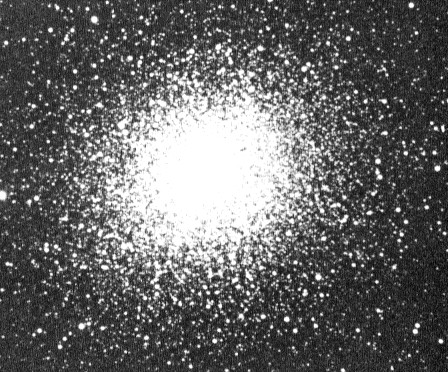
 Star clusters are fantastic objects to point your viewing instrument at because they're generally bright enough to see even with small binoculars.  The globular cluster M13, for example, is high in the sky all night this month in the constellation of Hercules - hence its unofficial title "The Hercules Cluster."  The image below (courtesy of SEDS) will give you an idea of what to expect.
Of course, this is an image taken with a camera so your view through the eyepiece won't be so rich or saturated, but you may find that you prefer the eyepiece view even better!  As you examine its stellar population, think about the fact that this cluster is believed to be at least twice as old as our solar system and contains several hundred thousand stars all packed into an area roughly 150 light-years across.  Try to count the stars yourself to see how many you can see with your equipment.  Imagine what the night sky would look like if you lived on a planet orbiting one of these stars.  Then go exploring to see what else you can find!

Happy viewing!

Friday, June 8, 2012

Venus Transit, Conquered

Oneonta weather gave us some challenges when it came time to observe the last Venus transit for 105 years, but it was worth it!  This entry is a description of the evening's event as I described it to the folks who write for the College news.

The evening began with a solid cloud deck and rain, but by 6:00 the rain had stopped and the clouds had slightly thinned. By that point, Shawn Grove (a 2012 SUNY Oneonta graduate) and I were joined by 5 or 6 people from the community in the observatory waiting for the weather to clear. The transit technically began at 6:03 p.m. here in Oneonta, and around 6:10 we were suddenly greeted with a thin spot in the clouds where we could see the disk of the Sun. Quickly we pointed the 14-inch telescope at it and were greeted with a view showing Venus approximately halfway through its "entrance" into the solar disk. It looked like a dark dimple in the edge of the Sun. Those who were present were very excited to see this, although it only lasted a few minutes before the clouds thickened up again. From then we waited for over an hour, watching as small gaps in the clouds passed by outside the vicinity of the Sun. More people from the community arrived, and some waited while others left.

Then at about 7:20 p.m. we saw sunlight streaming through another break in the clouds. By this time the Sun had dropped low enough that it was behind trees, so we couldn't see it from the elevated 14-inch dome. However, we did have a smaller 4.5-inch telescope with a solar filter on the ground that we could move. Grabbing it, we raced across the grassy lawn to a point where the Sun was visible. Venus was well into its transit by then so we were blessed with the view that is shown in the image below.

The clouds remained thin enough to see it clearly while the group of roughly 15 people, including several children, each took turns looking through the small scope.  A handful of people had gone into the woods to check out the nearby pond and when we called out to them they came sprinting out of the woods. Everyone was able to see it, many people took pictures with camera phones (and me with my digital camera), and by 7:45 p.m. the clouds obscured the Sun again just as it dropped below the tree line for good.

Part of the excitement was that "thrill of the hunt" feeling from waiting and then pursuing with the small telescope in hand. Another part of the excitement came from being able to witness an event that won't occur for another 105 years. However, I think the greatest satisfaction for me was being able to see people from the community come up in the hopes of seeing the transit, be rewarded for their diligence, and walk away feeling like it had been worth the wait.  Everyone was thrilled to have been able to see it.  Thank you to everyone who came out to see it!

Monday, June 4, 2012

Venus Transit of the Century

With a plethora of websites dedicated to tomorrow's transit of Venus across the face of the Sun, including a page on Wikipedia about it, I don't feel the need to wax eloquent about the upcoming event in too much detail. Numerous sources can be read to learn about the orbits of Venus and Earth, the importance it once had in determining the distance scales of our solar system, and so on. However, since this blog is dedicated to the observer in the Oneonta, NY region, you're probably wondering about when it will be visible.

The most recent transit of Venus occurred in early June of 2004.  This transit occurred in the early morning in North America, with viewers in New York seeing it already in progress as the sun rose.  This made the event a bit of a challenge to see, since getting up before the sun rises isn't on most people's list of favorite things to do.  In Michigan at this time, I would have been an undergraduate at Central Michigan University.  Since I was an avid astronomer and astronomy student at the time, if it had been visible then I'm sure I would have gone to see it at our school's telescope.  The fact that I don't have any memories of it makes me think it may have been cloudy that day.

For those who don't know me...I have a terrible memory.  Case in point: I currently have 13 Post-it notes on my desk at this very moment with reminders for various things!  Not to mention the five half-page sized pieces of paper with other various notes jotted on them and an index card of notes as well.  But I digress...

The 2012 Venus is visible in North America in the early evening until sunset, making it much more accessible for the average viewer.  Expected to begin at approximately 6:00 p.m. in Oneonta, the second planet from the Sun (and our closest planetary neighbor) will continue its sojourn across our star's face until well after the sun has set, giving us only a limited opportunity to watch it for approximately an hour and a half.

The current weather forecast is for clouds and possibly rain.  If you're a sucker for "once-in-a-lifetime" opportunities, you may want to take a trip somewhere else to watch it - preferably farther west where you can watch it for a longer time period.

HOWEVER!  The Internet now offers the couch-astronomer and those of us in cloudy parts of the planet the chance to watch this event live as seen from somewhere else. You can visit the website for the SLOOH Space Camera or NASA's live webcast from Mauna Kea, Hawaii. I recommend tuning into the webcast shortly before 6:00 p.m. EDT to make sure you see it.  If you want it to feel like you're really there watching it through a telescope, get a paper towel tube and hold it up to your computer screen.  Who says you need fancy equipment?  The Internet is pretty fancy in my opinion!

If you are in the Oneonta area and the weather magically happens to be clear in the late afternoon on June 5, come see us at the SUNY Oneonta observatory at College Camp.  We will have a couple telescopes with solar filters for safe viewing set up.  Don't look directly at the sun for this event, or permanent eye damage may result.  We will have safe equipment for viewing the event.  Our viewing of the Sun and the eclipse will be open to the public starting at 5:30 p.m.

If the weather looks bad, hop online and visit one of the websites above.  This is what I did for the most recent annular solar eclipse and it wasn't bad.  Better than missing it altogether, anyway!

Happy viewing!

Tuesday, May 29, 2012

How to Buy a Telescope for Yourself

Throughout this blog I have made reference to viewing various celestial objects and events through binoculars or a telescope, and this works fairly well if you already own one or both such instruments. However, suppose you don't own either one - or, suppose you own a pair of binoculars but are itching to buy a telescope. It is perhaps the most common question that novice astronomers and non-astronomers ask experienced amateur and professional astronomers: "I'd like to purchase my first telescope. What telescope should I buy?" Today I will provide you with some instructions and advice that should (hopefully) be of use to you as you begin shopping around. In a future entry I will explain how to purchase a telescope for your child.

Before You Begin
If you are new to the night sky, then I would suggest buying a pair of nice binoculars first. You can drop $100 at Walmart for a cheap telescope that will quickly disappoint, or you can buy a quality pair of binoculars at the same cost that will provide better image quality. Yes, you are losing out on magnification (although don't buy the pitch from the cheap retail telescopes that claim 500X magnification!), but what you are gaining is an easily-transported, well-made optical instrument that will introduce you to the night sky before you get lost using a new telescope.

Here is a common scenario: you enthusiastically run to the store to buy a telescope, spend $150 on one that promises incredible magnification and comes in a box plastered with amazing images of planets, nebulae, and galaxies, then take it home and don't know what to look at. This occurs because the telescope didn't come with a drive motor or computerized paddle - you know you'd like to look at Saturn, but don't even know where Saturn is.  You go inside also wishing you knew what season the constellation Orion was visible, pack the telescope in its box, and it subsequently collects dust.

Is the best choice to go buy a nice computerized telescope?  Not unless you'd like to spend $500 or more on something that will likely sit in your garage or basement for the foreseeable future.  Buying a nice pair of binoculars and a star atlas allows you to fall in love with the night sky.  Go outside, lay on a blanket, and use your star atlas to guide you from star to star through a constellation.  Binoculars have sufficient magnification (the first number in the specs: for example, "7x50" binoculars have a magnifying power of 7X and an aperture of 50 mm) as to reveal rich open star clusters, the phases of Venus, the Galilean moons of Jupiter, and exquisite lunar features.  Star-hopping like this helps to familiarize yourself with the night sky.  Using star maps from an atlas or an astronomy magazine, you can become an expert in night-sky viewing.  Then go buy a telescope.

Types of Telescopes
There are several different kinds of telescopes that can be differentiated by the optical elements they utilize and the mounts on which they are built.
  1. Refractors:  Refracting telescopes are long and narrow tubes with a glass lens on one end and an eyepiece on the other:
    These telescopes can be on equatorial mounts (shown above) or altitude-azimuth mounts (which are easier for pointing, harder for tracking).  Cheap models will have one simple lens at the aperture (the big end), while higher quality models will have a two-piece (achromatic) or three-piece (apochromatic) compound lens.  The more lenses, the better the image quality because these additional lenses are correcting for an effect called "chromatic aberration" where different colors are focused at different distances by the glass lens.  Of course, the more compound the lens, the higher the cost as well.  Many refractors are not motorized, although some of the high-end ones can be.
  2. Reflectors:  Reflecting telescopes utilize mirrors to focus the light rather than an aperture lens:
    These can be long or short, and most often have an open aperture with a mirror on the lower end.  The light is reflected off this mirror to a smaller, flat mirror up near the opening and then directed out the side of the telescope through the eyepiece.  Reflectors do not have chromatic aberration and typically offer more bang for your buck as far as aperture size goes.  The larger the aperture, the more light is collected - producing a brighter image with better resolution.  Equatorial mount reflectors can come in both motorized and non-motorized forms.
  3. Dobsonians:  Dobsonian telescopes are simply reflecting telescopes that sit on the ground in an altitude-azimuth mount:
    Other than this mount difference, they have the same characteristics as other reflectors while also providing much longer focal lengths - giving you higher magnification capabilities (provided you have the right eyepieces).  Dobsonians are almost never motorized, but many do come with a computer paddle that tells you which direction to move the telescope by hand.  This is a reasonable compromise between paying less for a non-motorized telescope while also having the advantage of a built-in object library.
  4. Schmidt-Cassegrains: The final "general" category is the Schmidt-Cassegrain Telescope (SCT) that uses both a lens and mirrors to focus light:
    These provide great image quality, high magnification potential, and are usually computerized...but they are also expensive. 

Choosing a Telescope
When you are ready to purchase your first telescope, there are a number of factors that you should consider.  These factors are (in no particular order):
  1. Budget
  2. Optical quality / aperture size
  3. Portability
  4. Time available for use
  5. Ease of use
Budget:  Most people consider budget the primary factor, and this is reasonable.  When buying a telescope, you can find them ranging in price from $100 to $10,000!  My first tip: don't run to a department store and buy that $100 one I mentioned earlier.  While affordable, these telescopes are mass-produced with low-quality optical elements and a wobbly mount.  Why does the mount matter?  If your telescope is constantly shaking and vibrating when you touch it and doesn't stay aimed at anything without drifting, your experience will be extremely disappointing.  Having a stable, sturdy mount is almost as important as having quality optics.  For your first telescope, plan on spending around $300-$400.  This will ensure that you have struck a good balance in quality and size for your first telescope.  Which brings me to the second factor...

Optical quality:  If the quality of the lens or mirrors in your telescope is poor, your viewing experience will be poor as well.  Department store telescopes are made with cheap glass lenses that offer more aberration than acclamation. A telescope retailer (either a store or online) will provide better quality options.  You want a telescope that uses quality lenses or mirrors!  This ties in with aperture size too.  In general, bigger is better.  However, bigger is also more expensive.  You'll need to strike a balance.  You can use a diagram like this to determine your optimal aperture size:

"Limiting stellar magnitude" in this diagram simply refers to the faintest object you can see through the telescope.  Larger numbers correspond to fainter objects.  Between 6-10 inches in aperture diameter typically provides a reasonable performance for its cost.  Refractors have smaller apertures than most reflectors, but can provide better images if you pay for it.  For reference, planets are bright, galaxies are faint.  Planets are easily visible in nearly all telescopes, while galaxies are only visible with larger apertures - typically greater than 10 inches.

Portability:  Will you be taking your telescope on trips, or will it always be used outside?  Will you be the one using it, or will your child?  Portability is an important thing to consider depending on your plans for the telescope.  Larger telescopes and sturdier mounts are heavier to move around and sometimes require a bit of dis-assembly to transport.  Additionally, if your telescope has a drive motor and/or computer it may require a source of electricity.

Time available for use:  How often do you envision the telescope being used?  Once a week?  Once a month?  Only once?  If you will use it a lot, you may wish to spend more on one that will provide a lifetime of viewing options - this generally means purchasing a larger telescope with a broad range of eyepieces.  If it will be used only on occasion, then don't spend more than $500.  If this might be used once or twice before interest in it wanes, don't spend more than $300.

Ease of use:  How good are you at learning to use new equipment?  Is this for a child or an adult?  Simple telescopes may look "too basic" but they are much easier to use than computerized telescopes.  They act as "point-and-shoot" telescopes, and all you really need to learn is how to point them using the axis knobs.  However, you also need to be familiar with the night sky.  Motorized, computerized telescopes make it very easy to find things...provided that you have it plugged in and set up properly and have done a correct alignment using several stars in the sky.  Motorized telescopes have thicker user manuals.

The Final Choice
After you have considered all these factors, it comes down to making a choice.  Many amateur astronomers will go with a 6- or 8-inch Dobsonian reflector and be very happy with it.  Others prefer to buy a nice 3- or 4-inch refractor and get superb views of solar system objects.  Motorized SCTs are extremely hard to find under $700 unless you buy one secondhand.  All things considered, I prefer to recommend getting as much aperture as you can afford.  A great 4-inch refractor is nice, but at the cost of something like that you can get a 12-inch reflecting telescope with a drive motor that will allow you to see many more types of objects than the smaller refractor.  Consider the factors I have mentioned above carefully, then talk to a telescope retailer to find one that will best fit your desires.

Resources
Check out some of these manufacturer websites to see your options and their costs: